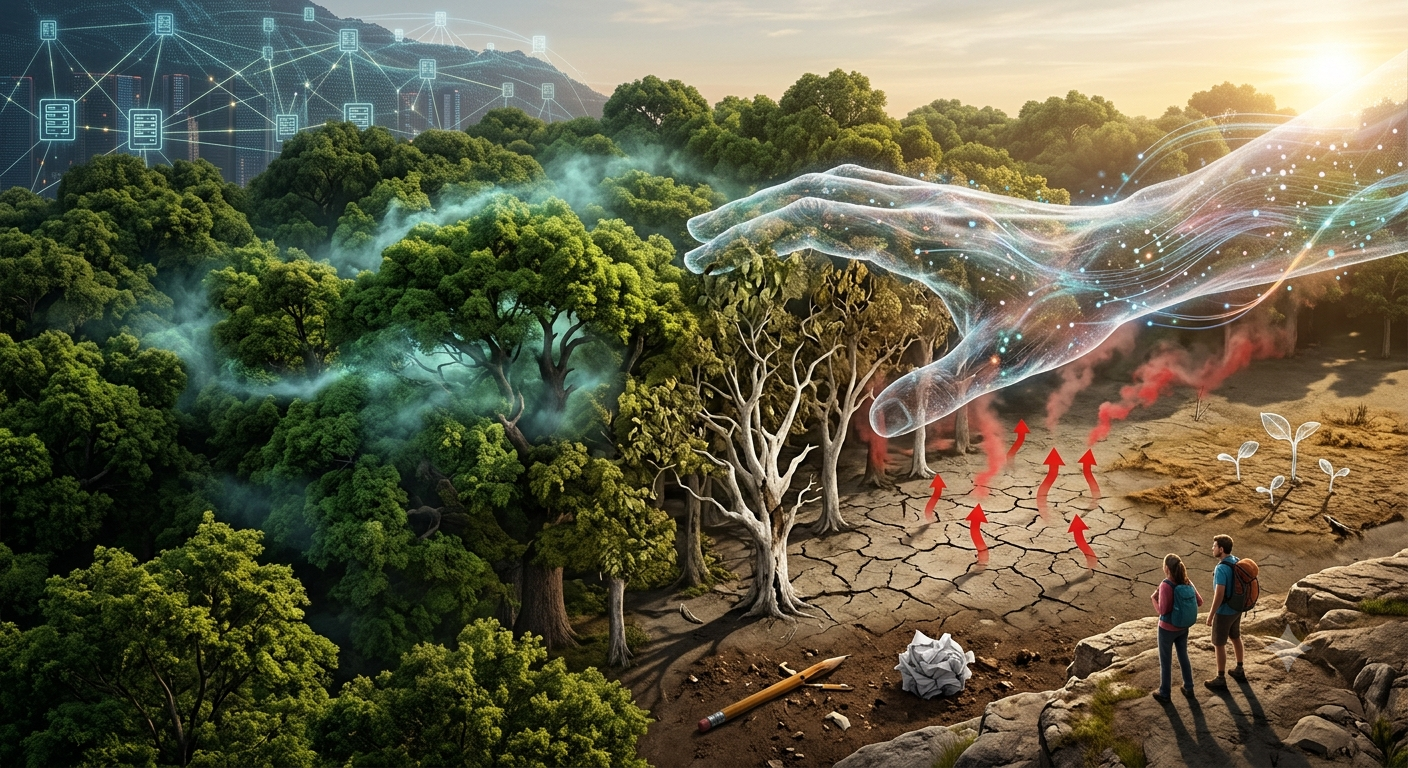
For years, the environmental rallying cry has been simple: “Think before you print.” We’ve been led to believe that swapping paper invoices, books, and memos for emails and digital documents is an unambiguous win for the planet. However, the relationship between the paper industry and forest conservation is far more complex than it appears. In a twist of ecological irony, shifting entirely away from paper toward digital communication could actually result in fewer trees and an increase in greenhouse gases.
To understand why, we have to look at the economics of forestry and land use.
The Economics of Managed Forests
The vast majority of paper does not come from the destruction of ancient, old-growth rainforests. Instead, it is harvested from sustainably managed tree farms. In these ecosystems, trees are grown as a crop, much like corn or wheat.
When the demand for paper is high, timberland owners have a strong financial incentive to keep planting and growing trees. For every tree harvested, sustainable forestry practices ensure that multiple seedlings are planted in its place. This economic cycle keeps millions of acres of land covered in dense, active forests.
The Threat of Land Conversion
If the demand for paper plummets due to a universal shift toward email and digital alternatives, the value of that timberland drops. Landowners still need to generate income, and if growing trees is no longer profitable, they will look for alternative uses for their property.
More often than not, this leads to permanent land conversion. Where there were once vast expanses of managed forests, landowners will sell to developers.
- Subdivisions and Housing:- Rolling hills of pines are cleared to make way for concrete foundations, asphalt roads, and suburban housing developments.
- Commercial and Industrial Hubs: Forested areas are paved over for strip malls, warehouses, and industrial parks.
Once a forest is converted into a housing development or an industrial complex, that land is lost to nature permanently. A harvested tree farm will grow back; a concrete parking lot will not.
The Impact on Greenhouse Gases
This shift from forestry to urban development has a double-whammy effect on atmospheric greenhouse gases, exacerbating climate change in two distinct ways:
1. The Loss of Carbon Sinks
Trees are natural carbon vacuums. Through photosynthesis, they absorb carbon dioxide CO2 from the atmosphere and store it as biomass. Young, rapidly growing trees in managed forests are particularly efficient at sequestering carbon. When these forests are replaced by houses and factories, we lose a massive, active “carbon sink.” Fewer trees mean more CO2 remains trapped in the atmosphere, warming the planet.
The fact that these trees are constantly replaced with new ones prevents them from becoming saturated.
2. The Carbon Footprint of “Going Digital”
Furthermore, digital communication is far from invisible to the environment. Every email sent, every document stored in the cloud, and every virtual meeting relies on massive, energy-hungry data centers.
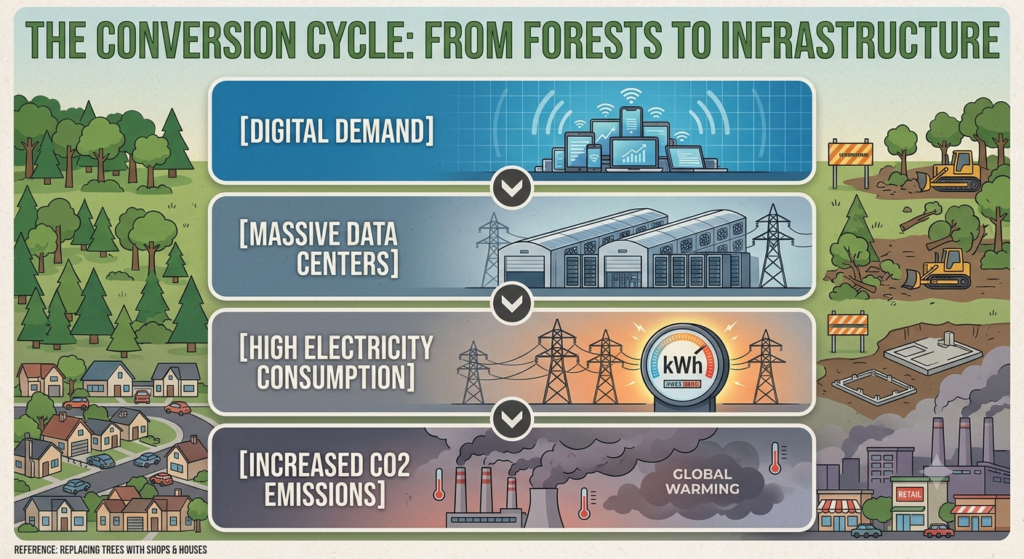
These data centres operate 24/7, requiring vast amounts of electricity not only to run the servers but also to keep them cool. Unless powered entirely by renewable energy, this digital infrastructure relies heavily on fossil fuels, actively pumping more greenhouse gases into the atmosphere.
3. Who Really Benefits from Reduced Paper Usage
Reducing paper usage when sending out statements, bills, catalogues, etc. Only benefits the corporations that no longer have to print the documents. These corporations are all behind the reduced paper usage, because it saves them a lot of money.
If a magazine is no longer printed, but distributed online. It can not be shared with friends. It can no longer be saved for a later date. It does not need to be printed or distributed. The cost to the consumer doesn’t change. The cost to the environment is huge because the trees are no longer grown to make the paper. In this example, only the magazine company benefits.
Rethinking the Green Narrative
The transition to a digital world offers undeniable convenience, but its environmental benefits have been oversold. By reducing our paper consumption to zero, we inadvertently dismantle the financial framework that keeps millions of acres of land forested.
Instead of automatically assuming digital is greener, we must recognize that supporting sustainable forestry is a vital tool in keeping our planet green. When we use sustainably sourced paper, we aren’t destroying a forest, we are paying to keep it standing.